To learn a language, you need a clear goal, a small daily routine and regular contact with the real thing, meaning listening, speaking, reading and writing. Fluency takes months or years, but you can reach useful conversation sooner than most people expect if you practise consistently.
This plan works for almost any language and any schedule.
Start with a specific goal
“Become fluent” is too vague to guide your study. A better goal is concrete: order a meal and chat with a waiter on a holiday, read a news article, or pass an exam at a named level.
The Common European Framework of Reference (CEFR) describes proficiency in six levels from A1 for beginners to C2 for near-native mastery. Many courses and exams use it, so naming a target level such as B1 gives you a benchmark to aim at.
Build a daily routine to learn a language
Thirty focused minutes a day usually beats a three-hour session once a week. Short, frequent contact keeps vocabulary active and makes the habit easier to hold.
| Activity | Example time | Skill trained |
|---|---|---|
| Vocabulary review | 10 minutes | Memory |
| Listening to a podcast or video | 10 minutes | Comprehension |
| Speaking aloud or with a partner | 10 minutes | Fluency |
| Short written entry | 5 minutes | Grammar in use |
Rotate the emphasis during the week so that no skill is ignored for long.
Learn the words that matter most
In every language, a small group of common words covers a large share of everyday speech. Start with those rather than rare vocabulary. Learn words inside short phrases, not as isolated items, so you pick up grammar and natural word order at the same time.
For long-term retention, review new words on a rising schedule; our guide to spaced repetition explains how to set one up with simple cards.
Speak early, even if it is clumsy
Many learners wait until they feel ready, and the feeling never arrives. Start speaking in the first weeks. Read sentences aloud, describe your surroundings to yourself, or book a regular session with a tutor or conversation partner.
Expect to make mistakes
Errors are information. When a partner corrects you, write the correction down and add it to your review cards. Over time, the same mistakes shrink.
Use listening as a daily base
Listening at a slightly challenging level builds your ear for rhythm and sounds. Replaying a short clip several times, first without text and then with a transcript, is a simple and effective exercise.
Fit practice into a busy week
You do not need a free afternoon to make progress. Listen to a podcast in the target language while cooking, label household objects with sticky notes, or switch your phone’s menus into the language you are studying. These small touches add up to many extra hours of contact over a year.
On very busy days, protect a five-minute minimum. Reviewing a handful of cards still keeps the habit alive, and habits are far easier to maintain than to restart.
Track progress honestly
Progress in languages is uneven and often invisible day to day. Every month, record yourself speaking for two minutes on a familiar topic and save it. Listening back after three months shows growth that daily practice hides.
Keep a log, too. A simple list of words learned, minutes studied and conversations had gives you evidence on the days when it feels like nothing is working.
Choosing resources wisely
Courses, apps, tutors and textbooks all have a place, but be wary of anything promising fluency in a few weeks. Check the syllabus, the sample lessons and the refund terms before paying. Our advice on choosing online courses wisely gives a short checklist you can reuse here. If you plan to speak publicly in your new language, practice with a friend first, and good note habits from our note-taking methods comparison will help you capture grammar rules in a form you can reuse.
For more study ideas, visit the education archive.
Key takeaways
- Set a concrete goal tied to a real situation or a CEFR level.
- Practise a little every day, covering all four skills across the week.
- Learn common words in phrases and review them on a schedule.
- Speak early and treat mistakes as useful feedback.
Frequently asked questions
How long does it take to learn a language?
It depends on the language, your native tongue, and how much you practise. Basic conversation can come within months, while advanced fluency usually takes years of steady exposure.
Is it too late to learn as an adult?
No. Adults often learn faster at the start because they can use study strategies and existing knowledge. Consistency matters more than age.
Should I learn grammar or just vocabulary?
Both. Vocabulary gets your meaning across, while grammar makes it clear and accurate. Learning words in whole phrases combines the two naturally.
How do I stay motivated?
Link study to something you enjoy, such as music, films or travel plans, and keep a visible log of your progress. Small, regular wins keep momentum going.
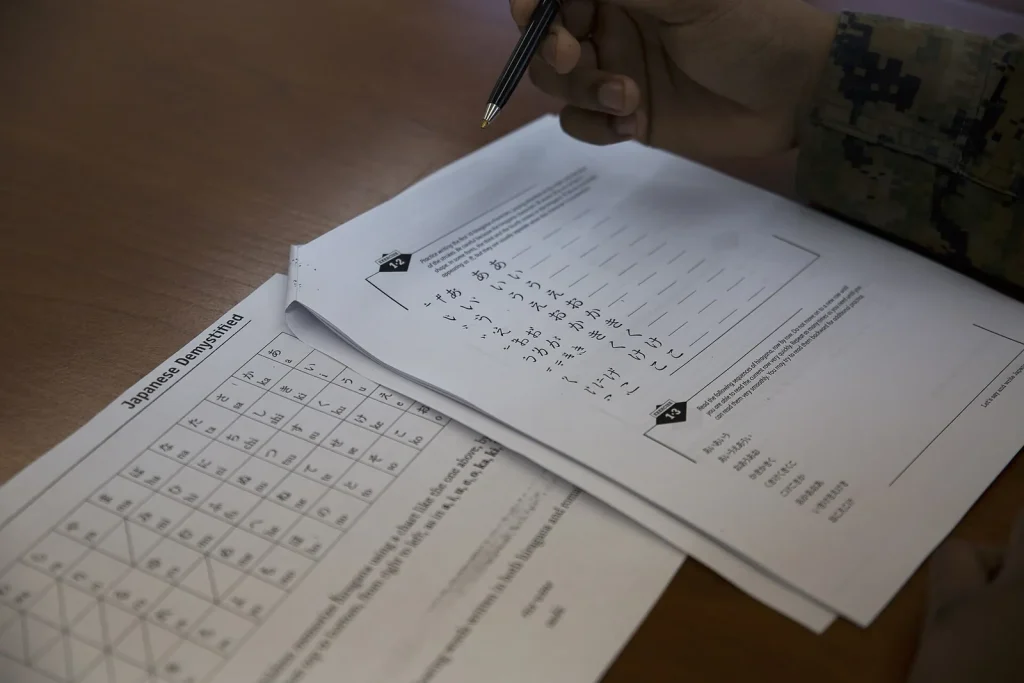
Photo: MCAS Futenma hosts Japanese language class for service members, families… by Cpl. Janessa Pon, Public domain, via Wikimedia Commons