If you’ve been staring at a trig problem wondering is cos x or y, you’re in good company. The two functions get mixed up all the time, mostly because both of them describe a point on the same circle. The answer, though, is clean: on the unit circle, cosine is the x-coordinate and sine is the y-coordinate.
The unit circle picture
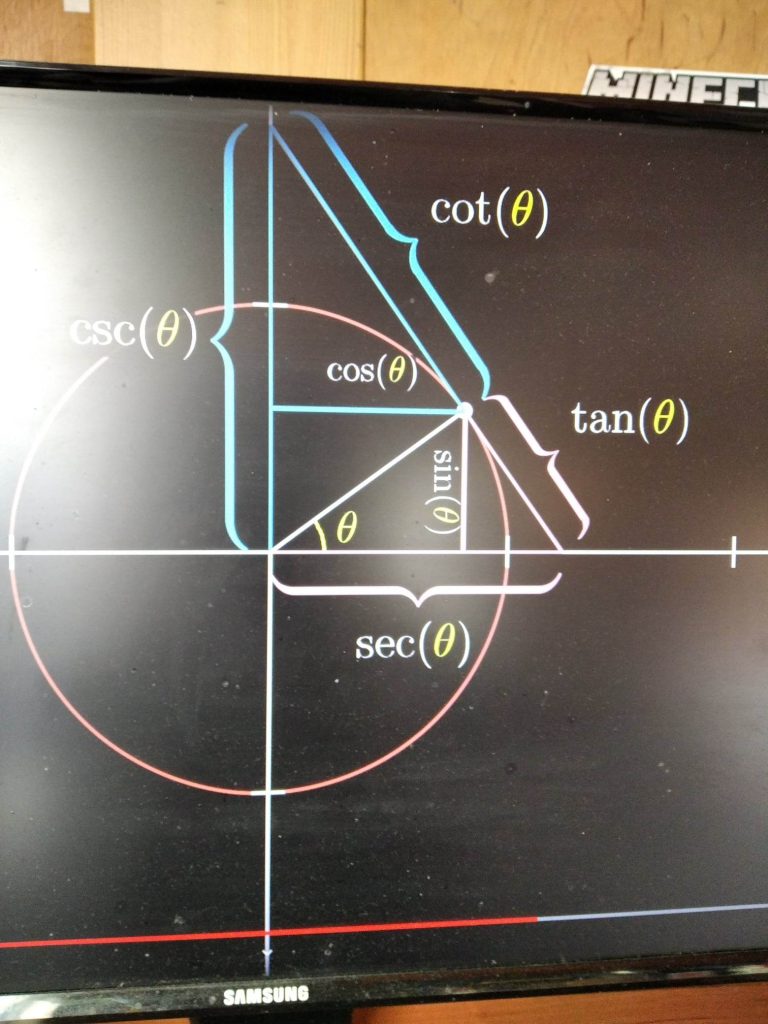
Imagine a circle with a radius of 1 centered at the origin of a graph. Pick any angle, measured from the positive x-axis going counterclockwise, and draw a line from the center out to the circle at that angle. The point where the line hits the circle has two coordinates. The horizontal one, x, is cos of the angle. The vertical one, y, is sin of the angle.
So when someone writes (cos θ, sin θ), they’re giving you the exact location of that point. Cosine comes first and sits in the x spot, which matches the way we write coordinates in the first place: x first, then y.
Why this makes sense
Think about a right triangle tucked inside the circle. The hypotenuse is the radius, so it equals 1. The side lying along the x-axis is the adjacent side, and the vertical side is the opposite one. Cosine is adjacent over hypotenuse, and with a hypotenuse of 1 that’s just the adjacent length, which is x. Sine is opposite over hypotenuse, so it’s the vertical length, which is y.
That’s the whole trick. It’s the same definition you learned with triangles, only now it lives on a circle where the numbers are easier to read.
Easy checks with common angles
Try a few angles and watch what happens:
- At 0 degrees, the point is (1, 0). Cos 0 = 1 and sin 0 = 0.
- At 90 degrees, the point is (0, 1). Cos 90 = 0 and sin 90 = 1.
- At 180 degrees, the point is (-1, 0). Cos 180 = -1 and sin 180 = 0.
Notice that cos starts at 1 and sin starts at 0. If you ever forget which is which, picture a starting angle of zero. The point sits all the way to the right on the x-axis, so x is 1. Since cos is the one equal to 1 there, cos must be x.
A memory aid that sticks
Some students remember it alphabetically. In the pair (x, y), the letter c in “cos” comes before s in “sin,” and x comes before y. That’s cos with x, sin with y. Another way is to say “cosine runs along the floor.” The floor is the horizontal axis, and the floor is the x-axis.
It’s also worth remembering that the two functions are shifted copies of each other. Cosine is just sine moved over by 90 degrees. If you graph both, you’ll see the same wave shape, only starting at a different spot.
Common mistakes to avoid
The biggest one is flipping the order when you write a point. If you list (sin θ, cos θ) by accident, you’ll end up with the wrong coordinates, and everything after that will look strange. Another slip happens when the angle is in radians but the calculator is set to degrees. Check the mode before you trust an answer.
People also forget that the signs change by quadrant. In the second quadrant, x is negative, so cosine is negative while sine stays positive. In the third quadrant, both are negative. A quick sketch of the circle clears this up faster than memorizing rules. If you want another place to double-check basics like these, compairro.com has short explainers on questions of this kind.
Putting it together
So the answer to the question is straightforward. Cosine gives you x, sine gives you y, and the unit circle shows why. Draw the circle, mark the angle, and read off the horizontal and vertical distances. Do that a few times and you’ll stop second-guessing it, which frees you up to focus on the harder problems waiting further down the page.