The best way to prepare for exams is to start early, test yourself often, and spread revision over several weeks instead of cramming. Active methods such as practice questions and past papers beat rereading notes, and they show you exactly where the gaps are.
The plan below fits four weeks, but you can stretch or squeeze it to match your own timetable.
Know what you are being tested on
Before revising anything, collect the facts: the exam date, the format, the time allowed, the marks per section and the syllabus or specification. Teachers and exam boards usually publish these, along with past papers and mark schemes.
Then break the syllabus into a checklist of topics and rate each one honestly as strong, shaky or weak. This list becomes your map for the weeks ahead.
Why retrieval practice beats rereading
Rereading feels comfortable because the material looks familiar, but familiarity is not the same as being able to recall it. Retrieval practice means closing the book and forcing yourself to write or say what you remember, then checking. It is harder in the moment and works much better over time.
Simple ways to do it include writing everything you know about a topic on a blank page, answering questions from a past paper, or explaining a concept aloud as if teaching a friend.
A four-week plan to prepare for exams
| Week | Focus | Main activities |
|---|---|---|
| 1 | Gather and organise | Syllabus checklist, tidy notes, make questions or cards |
| 2 | Weak topics first | Short daily sessions, practice questions, fix errors |
| 3 | Timed practice | Past papers under exam conditions, mark and review |
| 4 | Consolidate | Light review of summary sheets, rest, logistics |
Adjust for the number of subjects. If you have several exams, rotate subjects through each day so none gets left to the end.
Use past papers wisely
Do the first one open-book
Your first attempt can use notes so you learn the style of question. Later ones should be timed and closed-book, as close to real conditions as you can manage.
Mark carefully and learn from errors
Compare your answers with the mark scheme and note why marks were lost: a knowledge gap, a misread question or poor time management. Each type needs a different fix.
Revise in a way that sticks
Break study into blocks of around 25 to 50 minutes with short breaks, and keep your phone out of reach. Alternate subjects or topics instead of doing one for hours, since mixing them makes recall more flexible.
Return to earlier topics on a schedule. Our explainer on spaced repetition shows a simple system for doing this with cards, and good source material starts with tidy notes; the note-taking methods guide can help you reshape yours into summary sheets.
Make a realistic daily timetable
Write out each day of the revision period and block in fixed commitments first: school, work, meals, sport and family time. What remains is your real study time, and it is almost always less than you imagined.
Divide that time among subjects according to your topic ratings, not your preferences. It is tempting to spend hours on a favourite topic you already know well, so assign the biggest slots to the shaky and weak topics. Leave one afternoon each week empty as a catch-up slot, because plans rarely survive contact with real life.
Finally, end every session by writing down what you will do first next time. Starting is the hardest part, and a note waiting for you removes the decision.
Look after the basics
Sleep matters. Memories are consolidated overnight, so trading sleep for extra hours of study usually backfires. Eat regular meals, drink water and move a little each day, even a short walk.
If anxiety is getting in the way, speak to a teacher, school counsellor or doctor. Nervousness before a test is common, but you do not have to cope with it alone.
The final days and exam day
In the last two days, skim summary sheets and formula lists rather than learning new material. Prepare everything the night before: ID, pens, calculator if allowed, water and directions to the venue.
In the exam, read every question twice, plan your time by marks available, and answer the easier questions first to build confidence. If you are writing essay answers, the same planning principles from how to write a good essay apply under time pressure. For more learning guides, browse the education archive.
Key takeaways
- Start four weeks out and build a topic checklist rated by confidence.
- Test yourself instead of rereading.
- Do timed past papers and learn from every lost mark.
- Protect sleep and keep the last days light.
Frequently asked questions
How many hours a day should I study?
There is no single right number; it depends on your workload and how focused each hour is. Several focused sessions with breaks usually work better than one marathon day.
Is it ever too late to start revising?
No, but with less time you must prioritise. Focus on high-mark topics and your weakest areas, and use practice questions rather than rereading.
Should I study with friends?
Group study can help if you quiz each other and explain ideas aloud. It works less well if the session drifts into chat, so set a clear agenda first.
What if I blank during the exam?
Skip to a question you can answer, breathe slowly and return later. Writing down any related fact you remember can often unlock the rest.
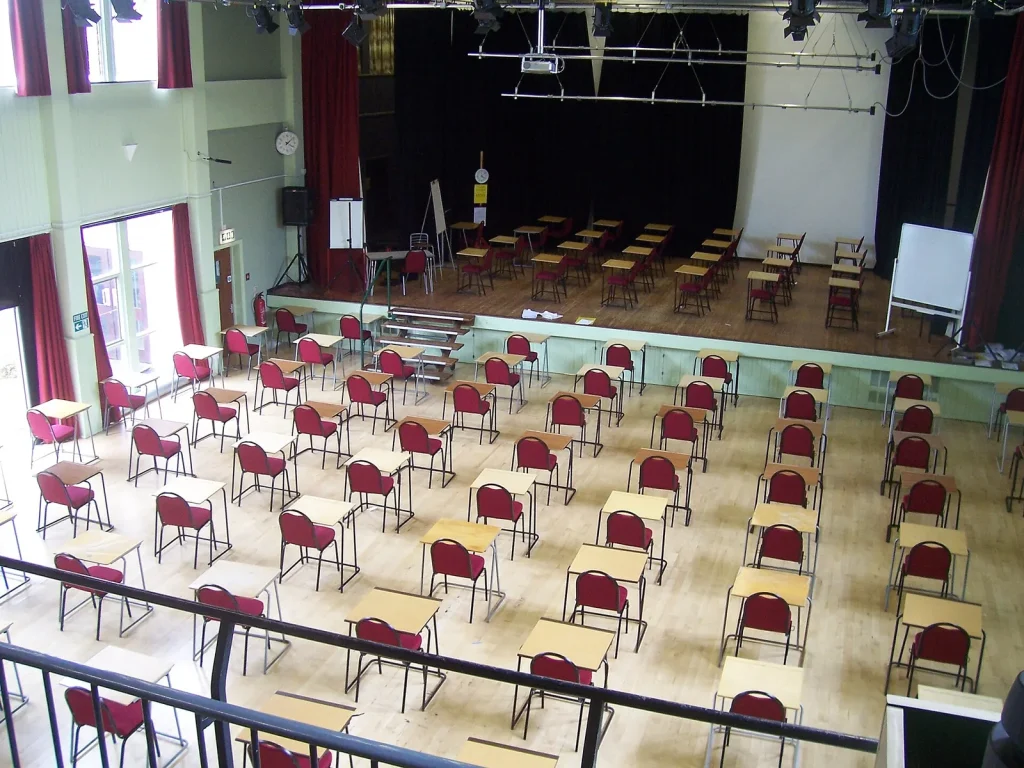
Photo: Richard Huish College Exam Hall by No machine-readable author provided. Lewser~commonswiki assumed (based on copyright claims, Public domain, via Wikimedia Commons