To read a news story well, start with who wrote it, when it was published, and whether it is reporting, analysis, or opinion. Then look at what is stated as fact, who is quoted as the source, and what is left unsaid. A few minutes of attention turns passive scrolling into informed reading.
Start with the label and the byline
Before the first paragraph, check what kind of piece you are reading. News reports aim to describe events. Analysis explains what they might mean. Opinion pieces, editorials, and columns argue for a point of view, and responsible outlets mark them clearly.
Next, look at the byline and date. A named reporter can be held accountable, and a date tells you whether the information is current. Old stories resurface constantly, and a three-year-old article can look brand new when it is shared without its date.
Understand the headline’s job
Headlines are written to be short, which means they simplify. They are written by editors as well as reporters, and they can overpromise what the article actually says. If a headline asks a question, the answer inside the story is often more measured than the headline suggests.
Read the first paragraph, known as the lede, before forming an opinion. It normally answers the basics: who, what, when, where, and why.
The inverted pyramid
Traditional news stories put the most important facts first and the less essential details later. This structure, called the inverted pyramid, lets readers stop at any point and still have the main facts.
| Part of the story | What to look for |
|---|---|
| Headline | The main claim, simplified |
| Lede | The key facts in one or two sentences |
| Body | Evidence, quotes, and context |
| Ending | Background, next steps, or reaction |
Look at the sourcing
Good reporting shows where its information comes from. Pay attention to how claims are attributed.
Named, anonymous, and documents
A named source who is in a position to know is generally stronger than an unnamed one, though there are legitimate reasons for anonymity, such as protecting someone from retaliation. Documents, data, and recordings add weight because readers can, in principle, check them. Be cautious about stories that rest on a single source or on phrases like “some say”.
Facts versus characterizations
“The council voted 5 to 4” is a fact. “The council narrowly dodged disaster” is a characterization. Learning to notice the difference is one of the most useful reading skills you can build.
Notice what is missing
No story can include everything. Ask whose perspective is absent, what comparison would help, and whether a number is given without context. If an article says a figure is “up 20 percent”, does it say from what level and over what period? The same question applies to economic data, which is why it helps to know what inflation reports measure.
How to read a news story: a quick checklist
- Identify the type of piece: news, analysis, or opinion.
- Check the author, outlet, and date.
- Read the lede and underline the verifiable facts.
- Note who is quoted and why they are credible.
- Look for what is missing or unexplained.
- Check whether a correction or update has been added.
Reputable outlets publish corrections when they get something wrong, usually at the top or bottom of the piece. Seeing one is a good sign about the outlet’s standards, not a bad one.
Putting it together
A good habit is to read a story twice. The first pass gives you the gist. On the second, slow down and mark each claim, asking whether the article shows evidence for it or simply asserts it.
Reading closely does not mean distrusting everything. It means matching your confidence to the strength of the evidence. When a claim seems surprising, use the routine in our guide to spotting misinformation. When a story covers government action, the explainer on how a bill becomes law helps you judge how far along something really is. You can find more reader guides in our News category.
Key takeaways
- Identify whether a piece is news, analysis, or opinion.
- Check the byline and date before the content.
- Headlines simplify, so read the lede and body.
- Look at who is quoted and whether claims are attributed.
- Separate verifiable facts from characterizations.
Frequently asked questions
How can I tell news from opinion?
Look for labels such as opinion, editorial, analysis, or column, and check whether the writer is arguing a position rather than reporting events. Reputable outlets usually mark the difference clearly.
Why do headlines sometimes not match the story?
Headlines are short and often written by editors, so they can simplify or overstate. Reading the opening paragraphs gives you the more precise version.
Is an anonymous source always unreliable?
No. Sources may stay anonymous to avoid retaliation. Judge the story by whether the outlet explains why, and whether other evidence supports the claim.
What does a correction at the end of a story mean?
It means the outlet identified an error and fixed it publicly. Taking responsibility this way is a sign of editorial standards.
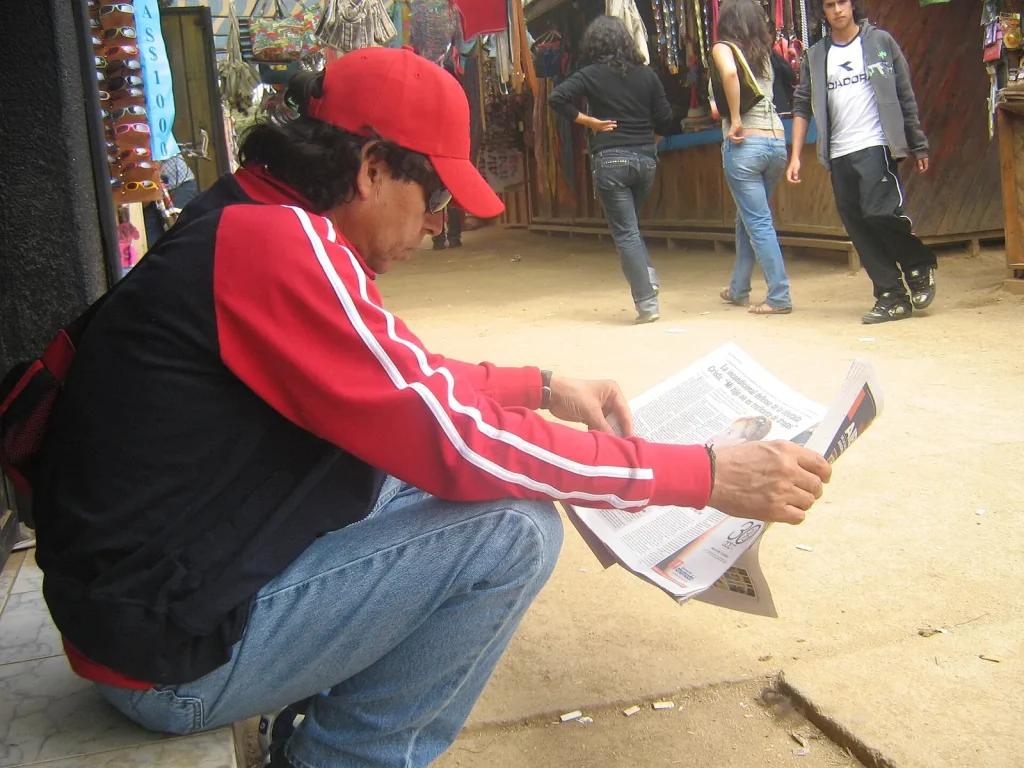
Photo: Man reading Las Últimas Noticias by Diego Grez, CC BY-SA 3.0, via Wikimedia Commons