Elections are counted in stages: ballots are gathered, tallied, checked, and only then certified as official. The numbers you see on election night are unofficial, which is why the picture can shift in the days that follow. Here is how elections are counted in general terms, so the process feels less mysterious.
How elections are counted: collect, tally, verify, certify
Every voting system, whatever the country, has to answer four questions. Who is allowed to vote? How are their choices recorded? How are those choices added up? And who signs off on the result?
The details differ from place to place, but the sequence rarely does. Ballots are cast, they are tallied, the totals are checked, and an official body declares the outcome. Keeping those four steps in mind makes most news coverage easier to follow.
How ballots are tallied
There are two broad methods, and many places use both. Hand counting means people read each ballot and record the choice. Machine counting uses scanners or electronic equipment to read marked ballots and produce totals.
Even where machines do the first count, people stay involved. Election workers open envelopes, check that ballots are complete, resolve unclear marks, and carry out the paperwork that ties every ballot back to a voter or a polling place.
Why in-person and mailed ballots can arrive at different speeds
Ballots cast at a polling place are usually counted at that location once voting ends. Ballots that arrive by mail often need extra steps first, such as verifying a signature or matching the ballot to a voter record. Rules about when those steps may begin vary by place, which is one reason totals can arrive in waves instead of all at once.
Unofficial results versus official results
When news outlets announce a winner, they are usually relying on unofficial tallies plus statistical analysis of what remains uncounted. That is a projection, not a legal declaration. The legal result comes later.
| Stage | What happens | Who is involved |
|---|---|---|
| Polls close | Voting ends; local counting begins | Local election workers |
| Unofficial results | Running totals are published | Election offices, news outlets |
| Canvass | Totals are reconciled and checked against records | Local or regional officials |
| Certification | The result is formally declared | Designated election authority |
The canvass is the quiet, careful part of the process. Officials compare the number of ballots to the number of voters recorded, review any ballots set aside, and correct clerical errors.
Why early numbers can change
A running total only reflects the ballots counted so far. If one kind of ballot is counted first and another kind later, the lead can move without anything going wrong. It is the same as watching a game when the score is shown before the final quarter has been played.
Small corrections also happen. A typing mistake in a spreadsheet, a memory card that was not uploaded, or a batch of ballots that was counted twice can all produce a visible jump. These are normally caught and fixed during the canvass.
Recounts and audits
A recount repeats the counting of ballots, usually because the margin is very narrow or because a candidate asks for one. The threshold for an automatic recount depends on local rules, so it is worth checking the rules for the specific election you are following.
An audit is different. Rather than recounting everything, auditors check a sample of ballots, often by hand, and compare it to the machine totals. If the sample matches, that is evidence the equipment counted accurately.
- Recount: counts all the relevant ballots again.
- Audit: checks a sample to test the accuracy of the original count.
- Certification: formally accepts the verified totals as the result.
How to follow a count calmly
A few habits help. Look for the official election office rather than a screenshot, note whether a figure is labeled unofficial, and ask how many ballots are still outstanding. The last question matters most, because a lead means little without it.
It also helps to know that slow does not mean suspicious. Careful counting takes time, and verification steps exist to protect accuracy. If you want to sharpen your instincts for judging what you see online, our guide to spotting misinformation pairs well with this one, and reading a news story closely will help you separate reported results from commentary.
For more explainers like this, browse the News category. If you want to see how laws rather than ballots move through a system, take a look at how a bill becomes law.
Key takeaways
- Counting happens in stages: tally, canvass, certification.
- Election-night totals are unofficial and can change.
- Different ballot types can be counted at different speeds.
- Recounts repeat the count; audits test a sample.
- Check the official source and ask how many ballots remain.
Frequently asked questions
Why does it sometimes take days to finish counting?
Mailed ballots, provisional ballots, and verification steps add time, and officials prioritize accuracy over speed. Rules about when certain steps can start also differ by place.
Who decides when a result is official?
A designated election authority, such as a county board or state or national election body, certifies the result after the canvass is complete. The exact body depends on the jurisdiction.
Is a news outlet announcing a winner the same as certification?
No. Outlets make projections from unofficial totals and statistical models. Certification is the formal, legal step that comes later.
What is the difference between a recount and an audit?
A recount counts the ballots again, while an audit checks a sample of ballots against the original totals to confirm the counting was accurate.
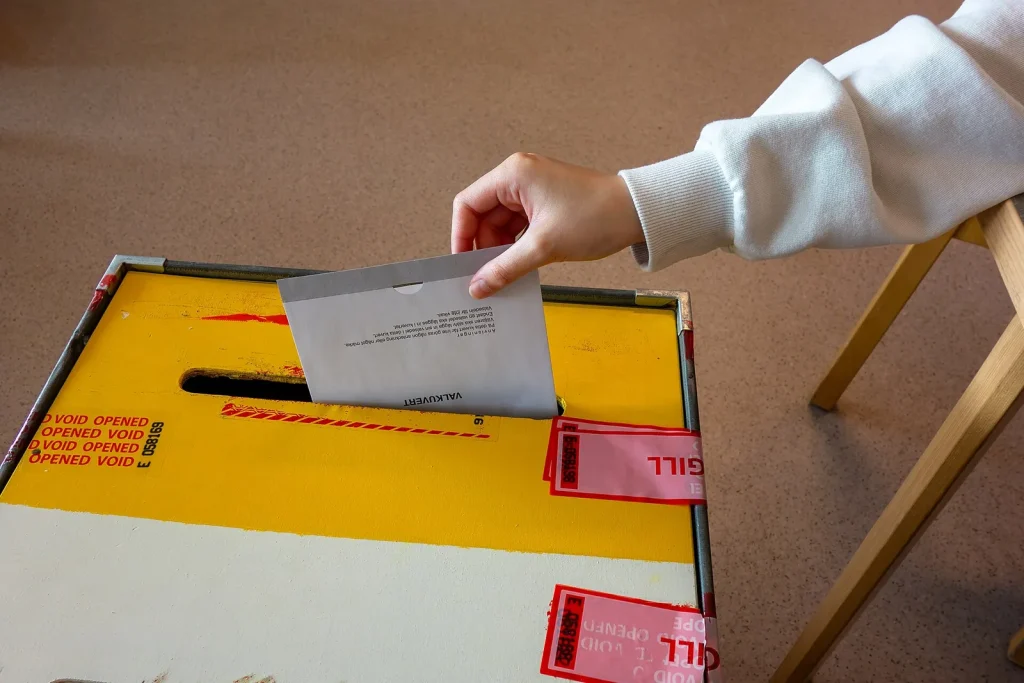
Photo: Ballot dropped into ballot box 2024 Swedish EU election at Stångenässkolan, Brastad by W.carter, CC BY-SA 4.0, via Wikimedia Commons