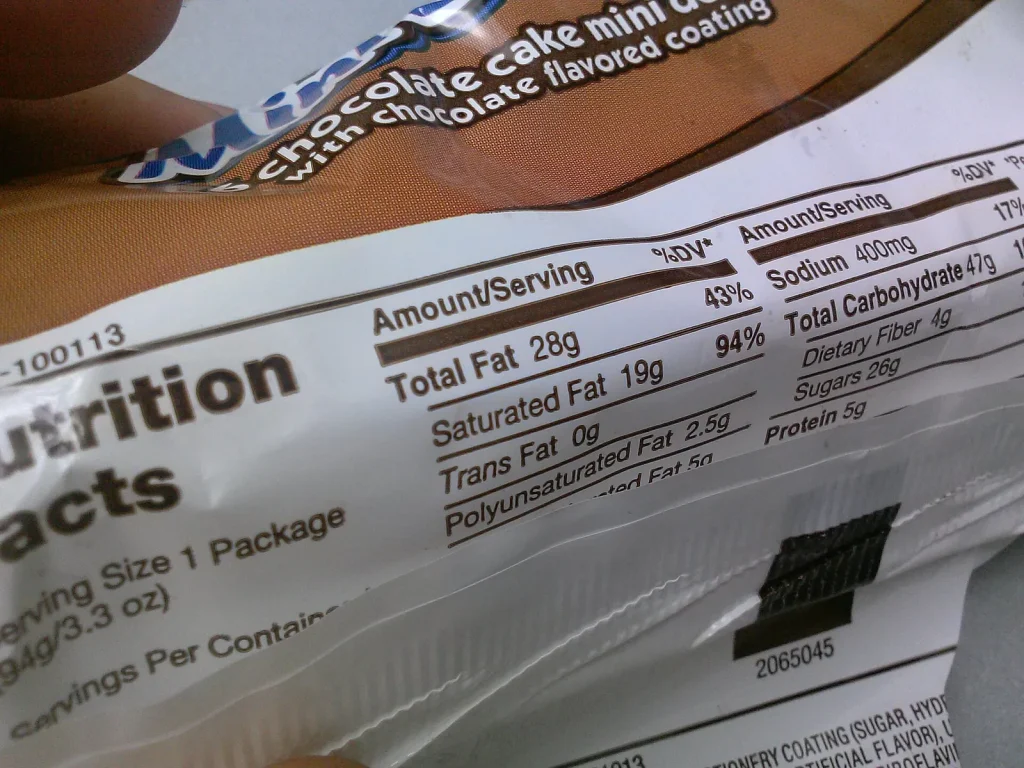
To read nutrition labels with confidence, start with the serving size, then look at calories, then the nutrients you care about, and finally the ingredients list. That order keeps the numbers in context and stops one flashy claim on the front of the pack from steering your choice.
Label formats differ between countries, but the logic is similar. Here is a practical walkthrough.
Step 1: Check the serving size
Every number on the label refers to a stated serving or a standard amount, such as per 100 g. In the US, the Nutrition Facts panel is built around a serving; in the UK and EU, labels usually show values per 100 g or 100 ml and often per portion as well.
This is where people trip up. A small bag may contain two servings, so eating it all means doubling every figure. Compare your actual portion with the one on the label before you do any maths.
Step 2: Look at the calories
Calories (shown as kcal in many places) tell you how much energy a serving provides. They are one piece of the puzzle, not a score of how good a food is. A handful of nuts and a sugary drink might share a calorie count, yet they offer very different things.
Step 3: Scan the nutrients that matter to you
You do not need to study every line. Pick what is relevant for you and your household.
- Total fat and saturated fat: useful when comparing similar products.
- Sodium or salt: sodium is listed in the US; salt appears on UK and EU labels. Salt is roughly 2.5 times the sodium figure.
- Total and added sugars: US labels show added sugars separately. Elsewhere you may need to check the ingredients to guess.
- Fibre: found in many whole grains, beans, fruit and vegetables.
- Protein: helpful to compare in things like yoghurt, bread and snack bars.
Step 4: Read the ingredients list
Ingredients are listed in descending order by weight. If sugar or refined flour appears near the top, it makes up a large part of the product. A short list of recognisable items is often a sign of a simpler food, though length alone does not make something good or bad.
Allergens
Major allergens, such as milk, eggs, peanuts, tree nuts, wheat, soy, fish, shellfish and sesame, must be declared in many countries, though the exact rules vary. They are often highlighted in bold or listed in a separate statement. If someone in your home has an allergy, check the label every time, because recipes change.
Comparing two products
Use the same unit to compare, ideally per 100 g, rather than per serving, since serving sizes vary. Here is an imaginary example of how that might look.
| Per 100 g | Cereal A | Cereal B |
|---|---|---|
| Energy | 380 kcal | 360 kcal |
| Sugars | 22 g | 9 g |
| Fibre | 4 g | 10 g |
| Salt | 0.9 g | 0.4 g |
These figures are made up purely to show the method. With your own products, you may value different rows depending on your needs.
Decoding front-of-pack claims
Words on the front are marketing, though regulated in many places. Treat them as prompts to check the back.
- Low fat: may be higher in sugar to compensate.
- Natural: has no single universal meaning on many labels.
- Multigrain: not the same as whole grain.
- No added sugar: the product may still contain natural sugars.
- Light or lite: can refer to colour, texture or reduced content, so look for the specifics.
Read nutrition labels as part of everyday cooking
You do not have to scrutinise every purchase. Take a few minutes on staples you buy often, such as bread, cereal, yoghurt, sauces and snacks, and settle on versions that suit you. Our meal prep basics and seasonal salad ideas are good places to put that knowledge to use. Cooking more from scratch, like in our vegetable soup recipe, also puts you in charge of the ingredients.
This article is general educational information, not medical or dietary advice. For personal nutrition needs, allergies or health conditions, please consult a doctor, registered dietitian or other qualified professional.
Key takeaways
- Start with serving size so the numbers match what you actually eat.
- Compare products per 100 g or 100 ml for a fair picture.
- Use the ingredients list to understand what a product is mostly made of.
- Always check allergen information if it affects you.
For more everyday wellness guidance, see our health archive.
Frequently asked questions
What should I look at first on a food label?
Check the serving size first, because all the other numbers depend on it.
What is the difference between sodium and salt?
Sodium is one part of salt. To convert, multiply the sodium amount by about 2.5 to estimate the salt content.
Are ingredients listed in any particular order?
Yes. They are listed from the largest amount by weight to the smallest.
Does the percentage daily value matter?
It can help you see whether a serving is relatively high or low in a nutrient. It is a general guide based on a reference diet, not a personal target.
Photo: Nutrition Facts label with 94% saturated fat per serving by B137, CC0, via Wikimedia Commons