Good knife skills come from three habits: a secure grip, a curled guide hand and a sharp, well-chosen blade. Master those and chopping becomes quicker, safer and more even, which also makes food cook more consistently.
You do not need a drawer of expensive knives. A decent chef’s knife, a small paring knife and a serrated knife cover nearly everything.
The three knives worth owning
- Chef’s knife (18 to 20 cm / 7 to 8 in): the all-rounder for vegetables, herbs and meat.
- Paring knife (about 9 cm / 3.5 in): for peeling, trimming and small, detailed jobs.
- Serrated knife: for bread, tomatoes and citrus.
Choose a knife that feels balanced in your hand. A comfortable one is easier to control than a fancy one.
Knife skills: how to hold the knife
The pinch grip
Pinch the blade just in front of the handle between your thumb and the side of your bent index finger, and wrap the other fingers around the handle. This gives much more control than gripping the handle alone, like a hammer.
The claw
Curl the fingertips of your other hand inward and tuck your thumb behind them. Your knuckles act as a guide, with the flat side of the blade resting against them. Fingertips stay safely out of the way.
Set up your board
- Place a damp cloth or non-slip mat under the board so it does not slide.
- Keep a bowl for scraps nearby.
- Cut flat sides on round vegetables like carrots so they sit steady.
- Work in a clear, uncluttered space.
How to dice an onion
- Cut the onion in half through the root, then peel. Leave the root end attached; it holds the layers together.
- Lay one half flat. Make horizontal cuts toward the root, parallel to the board, without cutting through it.
- Make vertical cuts from stem to root, close together.
- Slice across the onion to release even dice.
Even dice cook at the same speed, which is why recipes such as our easy vegetable soup start with a neat base of diced onion, carrot and celery.
Common cuts
| Cut | Approx size | Good for |
|---|---|---|
| Rough chop | Uneven, 2-3 cm / 1 in | Stocks, roasting |
| Dice | 1 cm / 1/2 in cubes | Soups, sauces |
| Batons | 5 cm x 1 cm / 2 x 1/2 in | Roasting, snacking |
| Slice | 3 mm / 1/8 in | Salads, stir-fries |
| Mince | Very fine | Garlic, herbs |
For one-tray dinners such as our one-pan chicken dinner, cut harder vegetables smaller and softer ones larger.
Why sharp is safer
A sharp knife bites into food and goes where you point it. A dull knife needs more pressure and is likelier to slip. Hone your knife with a honing steel regularly to realign the edge, and have it sharpened professionally or with a whetstone when it stops slicing a tomato cleanly.
Safety habits
- Never try to catch a falling knife. Step back.
- Carry knives pointing down, at your side.
- Wash knives by hand, one at a time, and never leave them in a sink full of soapy water.
- Store knives in a block, magnetic strip or sheath.
- Cut away from your body, and keep your focus on the task.
Clean your board and knife after cutting raw meat, and use separate boards for raw meat and ready-to-eat food. More on that in our hand washing and food safety checklist.
Slicing, rocking and chopping herbs
For herbs and garlic, keep the tip of the knife on the board and rock the blade up and down, pivoting through the pile with your guide hand resting on top of the spine. For slicing, use a long, smooth drawing motion rather than pressing straight down. Let the weight of the knife do most of the work.
Fragile items such as tomatoes and bread are better with a serrated blade, which grips the skin and saws through without squashing.
Practise on purpose
Speed comes from repetition. Spend ten minutes dicing an onion or slicing a few carrots, concentrating on the claw grip and a smooth rocking motion. Prepping vegetables for a week of meals, as in our meal prep basics, makes a perfect practice session.
Key takeaways
- Use the pinch grip and the claw hand every time.
- Keep knives sharp; a dull blade is more dangerous.
- Stabilise the board and flatten round items.
- Cut evenly so food cooks evenly.
More technique guides can be found in our food and recipes category.
Frequently asked questions
What is the best first knife to buy?
A good 18 to 20 cm (7 to 8 in) chef’s knife that feels comfortable and balanced in your hand.
How often should I sharpen my knives?
Hone regularly, and sharpen when the knife struggles to cut cleanly. For many home cooks that is once or twice a year.
Can knives go in the dishwasher?
It is best not to. Heat, detergent and knocking around can dull and damage blades and handles.
How do I stop crying when cutting onions?
A sharp knife helps, as does chilling the onion beforehand. Neither is guaranteed to work for everyone.
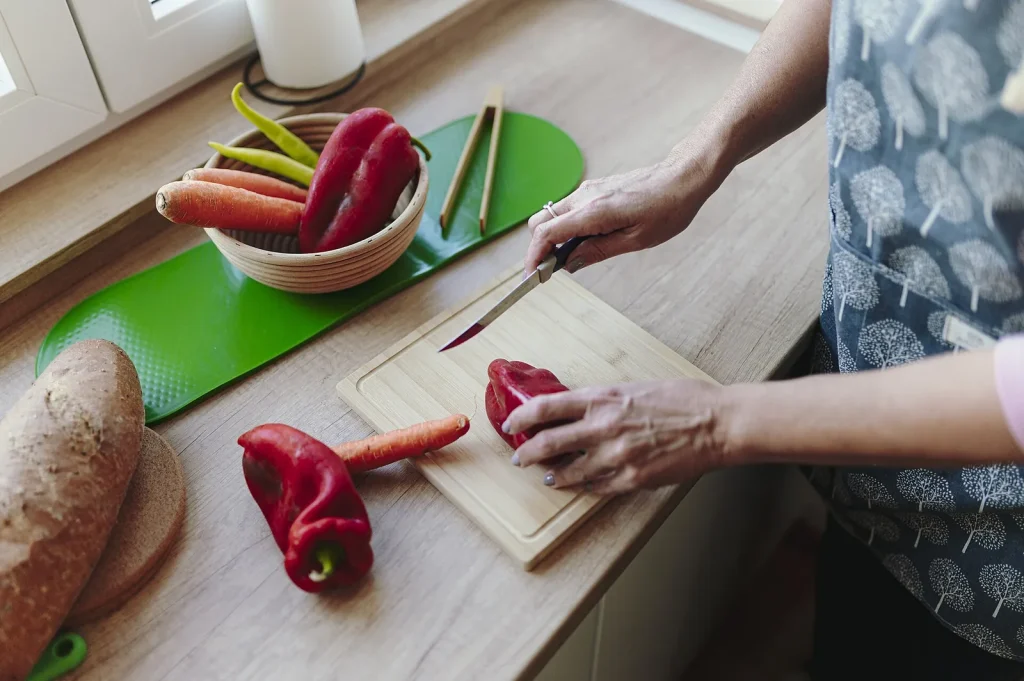
Photo: Woman prepares vegetables in kitchen with cutting board and knife during meal preparation by Shixart1985, CC BY 2.0, via Wikimedia Commons