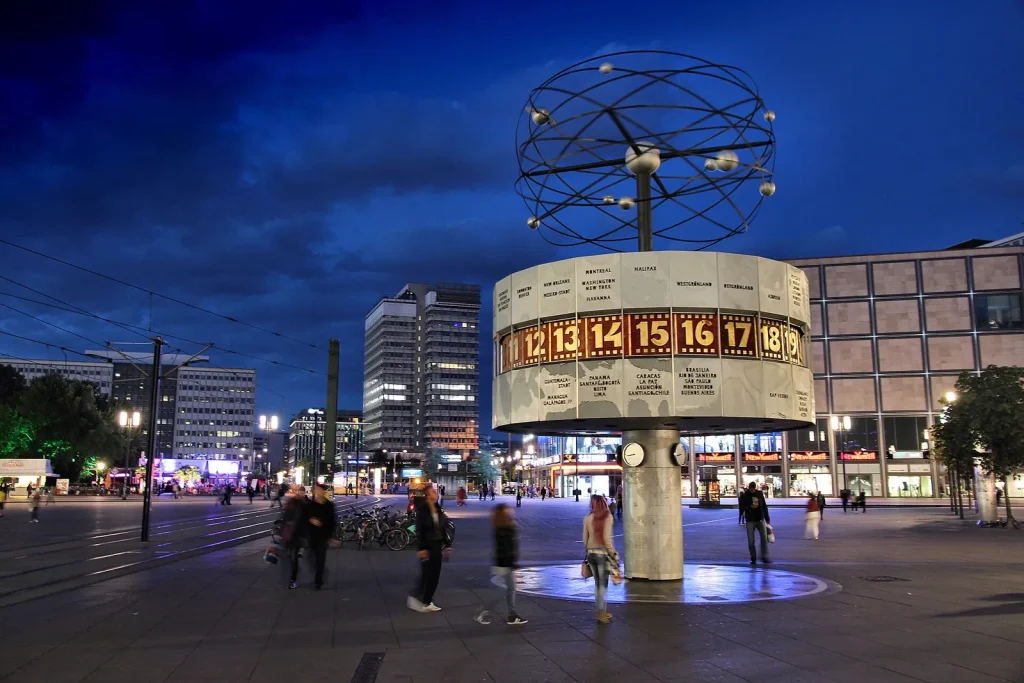
Time zones work by dividing the world into regions that share the same standard clock time, so that noon roughly matches the sun being high in the sky. There are about 24 of them in principle, each about one hour apart, though real-world borders make the map far messier. Here is how the system came about and why it looks the way it does.
Why we need time zones
The sun reaches its highest point at different moments in different places. Before standard time, towns set clocks by local solar noon, so one town’s time could differ by several minutes from the next town over.
That was fine when travel was slow. Once railways connected distant places in the nineteenth century, timetables built on dozens of local times became unworkable. Railway companies, and later governments, adopted standardized zones to fix it.
How time zones work: the basic geometry
The Earth turns through 360 degrees of longitude in about 24 hours, which works out to roughly 15 degrees per hour. That gives the classic picture of 24 vertical slices, each an hour apart.
The starting point is the prime meridian, which runs through Greenwich in London. Time at that reference is the basis for Coordinated Universal Time, or UTC, the standard from which every zone is measured as an offset, such as UTC+1 or UTC-5.
UTC versus GMT
The two are often used interchangeably in daily life. GMT is a time zone, while UTC is a precise time standard kept using atomic clocks. For practical purposes the two match closely.
Why the real map is untidy
Countries and regions choose their own time to suit politics, trade, and convenience, so zone boundaries rarely follow straight lines.
- India uses a single time, UTC+5:30, which is a half-hour offset.
- Nepal uses UTC+5:45, a quarter-hour offset from its neighbor.
- China spans a vast east-to-west distance but officially uses one standard time.
- The United States has several zones, including Eastern, Central, Mountain, and Pacific, along with others for Alaska, Hawaii, and territories.
Offsets like these show that a time zone is a legal and social decision as much as a geographic one.
The International Date Line
Somewhere, the calendar date has to change. The International Date Line, running roughly along the 180-degree meridian through the Pacific Ocean, serves as that marker, bending around some islands and territories to keep neighbors on the same day. Cross it heading east and you go back a calendar day; head west and you move forward one.
Daylight saving time
Some places move their clocks forward in warmer months and back in cooler ones, to shift daylight toward evening hours. Not all regions do this, and those that do change on different dates, which is a common source of scheduling confusion. Arizona, for example, does not observe it in most of the state, and many countries near the equator have no reason to.
Example: planning across zones
| City | Standard offset from UTC |
|---|---|
| London | UTC+0 |
| New York | UTC-5 |
| Los Angeles | UTC-8 |
| Delhi | UTC+5:30 |
These are standard-time offsets; during daylight saving periods, where it applies, they shift by an hour. When you schedule a call across zones, always state the zone, or better yet use a calendar tool that converts for each person. Teams that work across regions benefit from the habits in remote team habits that work, and careful scheduling is part of good meeting etiquette.
Tips for dealing with time zones
- Write times with the zone, such as “3 p.m. Eastern”.
- Use UTC for anything that must be unambiguous, such as logs or deadlines.
- Double-check dates near the changeover days for daylight saving.
- Remember that forecasts and alerts are issued in local time, as explained in how weather forecasts work.
For other explainers on how everyday systems operate, browse the News category.
Key takeaways
- Time zones standardize clock time so that noon roughly matches the sun.
- UTC is the reference, and zones are offsets from it.
- Some places use half-hour or 45-minute offsets.
- The International Date Line is where the calendar day changes.
- Always name the zone when scheduling.
Frequently asked questions
How many time zones are there?
In theory there are 24, one for each hour. In practice there are more distinct offsets because some places use half-hour or 45-minute differences.
What is the difference between UTC and GMT?
GMT is a time zone based on the Greenwich meridian, while UTC is a precise time standard kept by atomic clocks. In everyday use they give the same clock time.
Why does China have only one time zone?
China is wide enough to span several zones geographically, but it officially uses a single standard time for the whole country, a decision made for national consistency.
Why do some places not observe daylight saving time?
Places near the equator see little seasonal change in daylight, and some regions have simply decided it is not worth the disruption.
Photo: 001 Weltzeituhr Alexanderplatz – World Time Clock at Alexanderplatz, Berlin, Germany by Marek Ślusarczyk (Tupungato) Photo portfolio, CC BY 3.0, via Wikimedia Commons