Spaced repetition is a study method where you review material at increasing intervals instead of all at once. Reviewing something just as it starts to fade tells your brain it is worth keeping, so the memory lasts longer with less total effort.
It is one of the most reliable ideas in learning research, and you can start using it today with nothing more than a pen and a stack of index cards.
Why spacing works
In the 1880s the German psychologist Hermann Ebbinghaus tested his own memory with lists of nonsense syllables. He found that recall drops quickly at first and then levels off, a pattern now called the forgetting curve. He also found that repeating material after a gap helped it stick better than repeating it straight away.
The practical lesson is simple. Cramming feels productive because everything is fresh, but that freshness disappears within days. Spreading the same hours over weeks produces memories that survive.
The core rhythm of a spaced repetition schedule
There is no magic set of numbers, but most schedules follow the same shape: a short gap after first learning, then a longer one each time you recall the item correctly. If you get it wrong, it goes back to the start of the ladder.
| Review | Example gap | If you forgot |
|---|---|---|
| First | Next day | Repeat tomorrow |
| Second | 3 days later | Back to day 1 |
| Third | 1 week later | Back to day 1 |
| Fourth | 3 weeks later | Back to day 1 |
| Fifth | 2 months later | Back to day 1 |
Treat these gaps as a starting point. If cards feel too easy, stretch the gaps; if you keep missing them, shorten them.
Build a paper system with the Leitner method
The Leitner system, described by the German science journalist Sebastian Leitner in the 1970s, needs only cards and a few boxes. It is a tidy way to run spaced repetition without any software.
- Write one question on the front of a card and the answer on the back.
- Put every new card in Box 1 and review that box daily.
- Move a card up one box when you answer correctly.
- Send a card back to Box 1 when you get it wrong.
- Review higher boxes less often, for example every three days, weekly and fortnightly.
Within a couple of weeks the cards you know well sit in the high boxes and rarely cost you time, while the stubborn ones get the attention they need.
Write cards that actually work
A schedule cannot rescue a badly written card. Keep each card to a single fact or idea, and phrase the front as a question that forces you to produce the answer rather than simply recognise it.
Aim for one idea per card
A card that says “List the causes of the French Revolution” invites a vague guess. Several small cards, each asking about one cause, give you clean feedback on exactly what you know.
Use your own words
Copying a textbook sentence onto a card is easy but shallow. Rephrasing the idea forces you to understand it first, which makes the later reviews more meaningful.
Where spaced repetition fits best
It shines for material built from many small pieces: vocabulary, dates, formulas, anatomy terms, legal definitions. It is less suited to skills like essay writing, where practice matters more than recall. If you are building vocabulary for a new tongue, our guide on how to learn a language shows where cards fit alongside speaking and listening.
It also pairs well with exam work. Starting early and revisiting topics on a rolling basis is the backbone of any plan to prepare for exams without a last-week panic. And the quality of your source notes matters, so see our comparison of note-taking methods for ways to capture material you can turn into cards.
Making the habit stick
Ten to fifteen minutes a day beats a two-hour weekend session. Attach the review to something you already do, such as your morning coffee or the commute, and keep the daily pile small enough that finishing it feels easy.
Missing a day is not a disaster. Just do the overdue cards next time and carry on; the schedule is a guide, not a contract. Browse more study guides in our education archive.
Key takeaways
- Review material at growing gaps instead of cramming it in one sitting.
- Failed items go back to short intervals; successful ones move to longer ones.
- Write small, single-idea cards in your own words.
- Short daily sessions work better than long occasional ones.
Frequently asked questions
How often should I review flashcards?
Start with a daily review of new cards, then lengthen the gap each time you recall one correctly. Days, then a week, then several weeks is a common pattern.
Is spaced repetition only for memorising facts?
It is best for fact-heavy material, but the underlying idea of revisiting concepts over time also helps with understanding. Skills such as writing need regular practice as well.
Do I need an app to use it?
No. A set of index cards and a few labelled boxes is enough to run a full schedule. Apps simply automate the sorting.
How many new cards a day is sensible?
Many learners find 10 to 20 new cards a day manageable. Because each card returns for review, going much higher can create a pile that feels overwhelming.
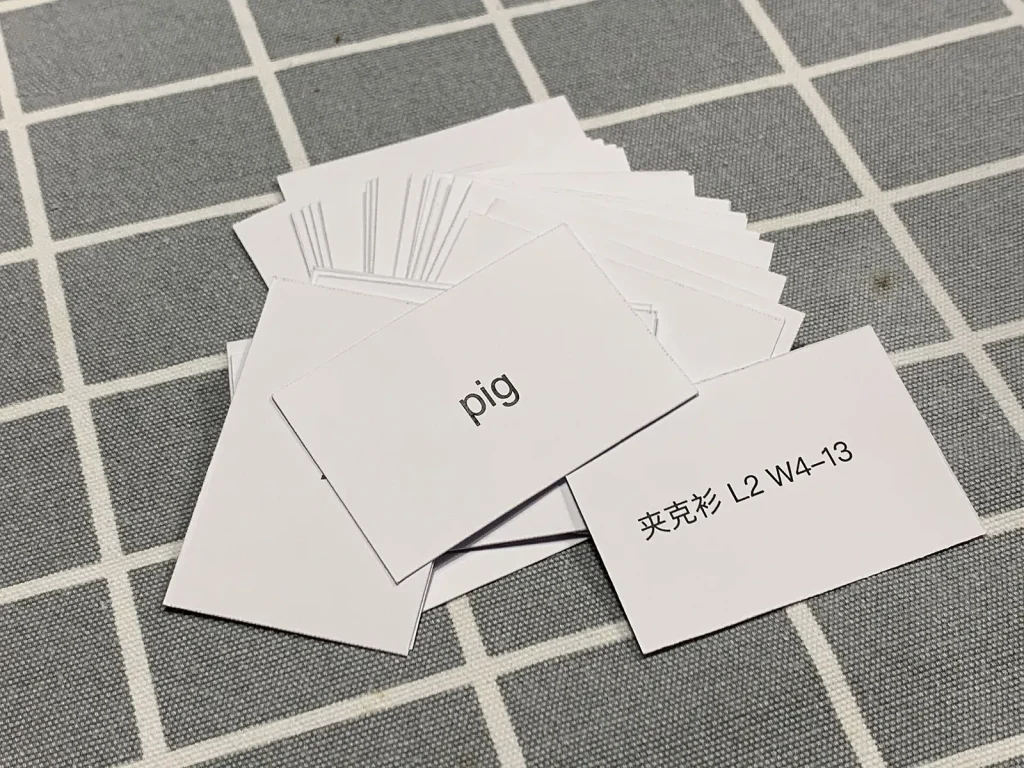
Photo: Flash cards for language learning by bfishadow, CC BY 2.0, via Wikimedia Commons